Introduction
Farmers’ land use decisions directly impact water quality. For conservation professionals looking to address water quality issues, it is essential to understand farmers’ perspectives on water quality and conservation practices before building education, outreach, and incentive-based programs. Like environmental indicators on water quality, monitoring social indicators such as attitudes, behavior, capacity, and constraints is equally important. Results of the monitoring help establish a baseline in human dimensions alongside environmental outcomes, enabling conservation professionals to track behavioral change that is a precursor to environmental change.
What is the level of farmers’ self-perceptions of their ability to improve water quality by changing their agricultural practices? What are major programming and incentive needs from farmers to change farming practices? This article shares highlights from a social indicator survey project designed to answer these two questions. While this survey focuses on vegetable rotations, the underlying social dynamics and behavioral barriers can apply to other mixed agricultural watersheds with long-standing overlapping water quality concerns.
Background
In 2023, project leads Anna Mitchell and Guolong Liang (UW-Madison Extension), with partners from Land & Water Department at Adams County, and Department of Natural Resources (DNR), gathered social indicators from farmers in two watersheds in central Wisconsin: The Ten Mile Creek Watershed and Fourteen Mile Creek Watersheds.
These watersheds lie within Wisconsin’s Central Sands region, an area facing widespread nitrate contamination that threatens drinking water and local ecosystems. The Fourteen Mile Creek Watershed was part of an active 9-Key Element Plan – a comprehensive watershed scale project focused on reducing the impacts of nonpoint source pollution to surface and groundwater resources. Adams County Land and Water Conservation (LWCD) manages this plan and developed incentive-based programs to help farmers adopt conservation practices aimed at improving water quality. To complement these efforts, project leads partnered with Adams County LWCD to assess whether a social indicator survey could strengthen the plan. They determined that such a survey would provide valuable insights into the practicality of existing incentives for growers, while also creating an opportunity to build relationships with farmers and better understand community needs for water-related education (Genskow and Prokopy, 2011, Figure 1). By collecting and tracking social indicators over time, conservation professionals in this region can better target education and outreach activities and evaluate whether these achieve the intended changes to protect water quality.
Through in person interviews, project leads built relationships with stakeholders in the Ten and Fourteen Mile Creek Watersheds. During spring and summer 2023, they visited twelve farms for one-on-one conversations, using the survey as a guide while encouraging farmers to share additional thoughts. As a follow-up, project leads hosted a private gathering for participating farmers to review the survey results first. Since then, findings have been shared with Land and Water Conservation staff, citizen organizations, DNR partners, and state legislators.
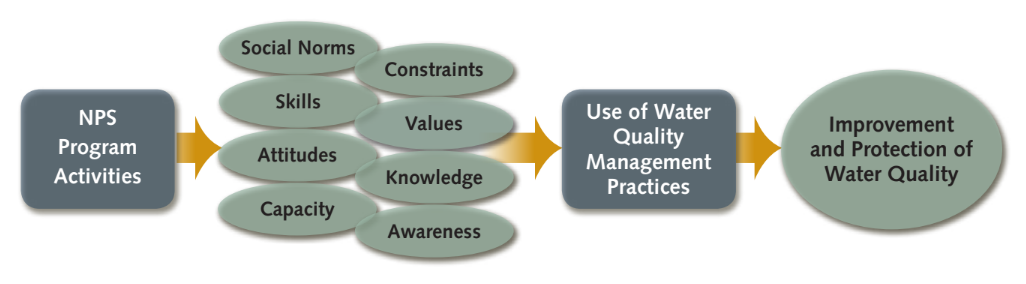
Figure 1: Image Description ↓
A linear, left-to-right conceptual flowchart mapping behavioral and environmental outcomes. It consists of three primary milestones connected by thick gold arrows:
- Left block (dark gray rectangle): “NPS Program Activities”
- Middle section (cluster of eight green ovals): Outlines individual factors influenced by the activities: “Social Norms”, “Constraints”, “Skills”, “Values”, “Attitudes”, “Knowledge”, “Capacity”, and “Awareness”.
- Middle-right block (dark gray rectangle): “Use of Water Quality Management Practices”
- Far-right block (green circle): “Improvement and Protection of Water Quality”
Results
Across various farm sizes and crop types, farmers expressed similar attitudes, awareness, and constraints towards conservation practices and water quality. Twelve farmers within the two watersheds participated in the survey. In total, surveyed participants operate on 91,452 acres of cropland (some reaching beyond watershed boundaries), growing 18 different crops in rotation lengths varying from three to seven years (Figure 2). Crop rotation length and diversity align with previous analysis of Wisconsin Central Sands rotations (Heineman and Kucharik, 2022).The average farm size is 7,621 acres with the overall size ranging from 560 acres to 25,000 acres. The majority of operating acres are adjacent to surface water (91.7%).
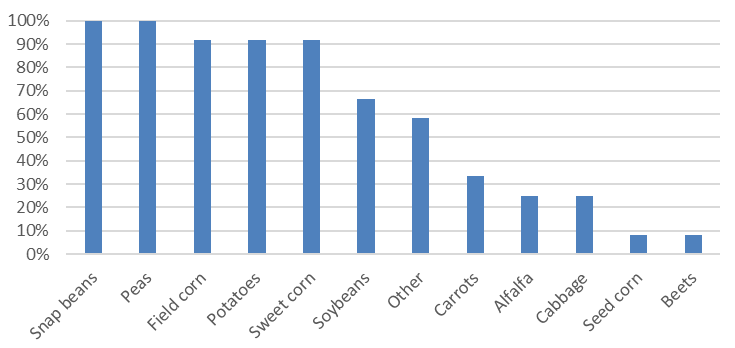
Figure 2: Image Description ↓
A vertical bar chart plotting crop types against a y-axis scaled from 0% to 100% in increments of 10%. Blue bars represent the data values for twelve crop categories arranged along the x-axis from left to right:
- Snap beans: 100%
- Peas: 100%
- Field corn: ~92%
- Potatoes: ~92%
- Sweet corn: ~92%
- Soybeans: ~66%
- Other: ~58%
- Carrots: ~33%
- Alfalfa: 25%
- Cabbage: 25%
- Seed corn: ~8%
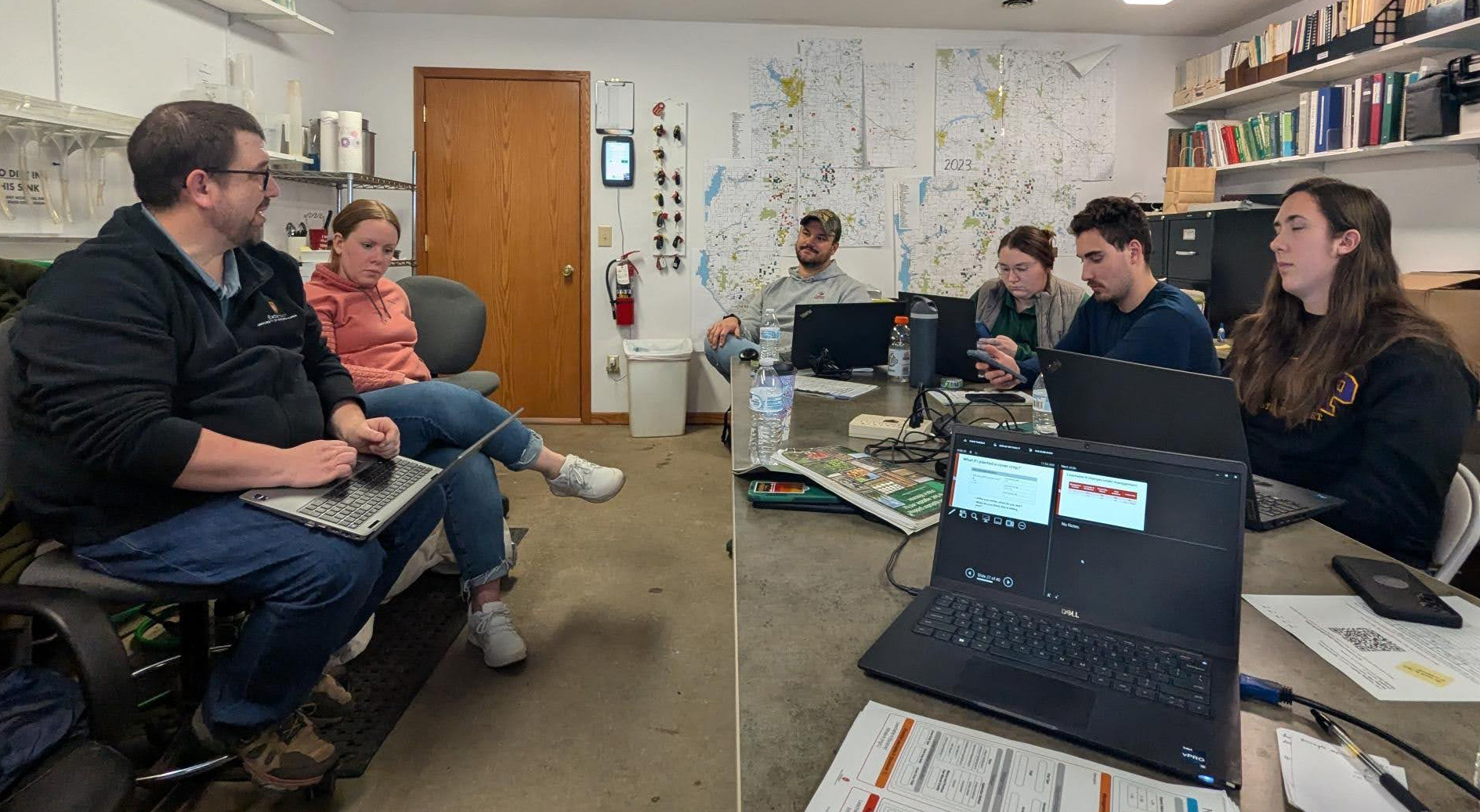
Multiple participants mentioned the use of double cropping in their potato rotations, while others expressed doubts about the practice, citing concerns and questions around soil health and profitability. This insight led to better understanding of educational needs and will be a theme of Extension programming focused on diversifying potato crop rotations in Wisconsin’s Central Sands. Half of the participants said they often co-manage part of the rotations with agronomists, neighboring farmers, and processors. Co-management included many aspects such as irrigation scheduling and nutrient management. Recognizing the critical role agronomists play in farm operations, the Extension Agriculture Water Quality Program and NRI Water Program developed and delivered nitrate leaching workshops tailored for agronomists working in these agricultural systems. From 2023-2025, three workshops have been offered to various agronomy groups (Figure 3).
Attitudes on Water Quality
Interviews began with conversation focused on local water quality. All 12 participants rated the quality of groundwater and surface water as good or very good. When asked about water quality in relation to specific activities, all participants rated their water quality as good or very good for irrigation use. Ten participants rated water quality as good or very good for boating or paddling activities, drinking water, household use, and swimming.
Although all participants rated groundwater and surface water as good or very good, two-thirds still viewed contaminated drinking water as a local concern and more than half (67%) recognized loss of nutrients to groundwater as a problem. This finding has helped Water Program Natural Resources Educators recognize the need for educational programming that explains groundwater uses and strategies for protecting drinking water.
The survey asked participants to rate how much of a problem various sources of water quality pollution were in their local area. The source identified as most problematic was the excessive use of lawn fertilizers—most participants rated this as either a moderate or severe problem. In contrast, excessive use of fertilizers for crop production was generally viewed as only a slight problem.
This perspective was echoed during the follow-up gathering with participating farmers. One participant noted, “A lot of people forget about the excessive use of lawn fertilizers, and fingers are pointed at farmers,” while another added, “Lakefront property owners don’t like to look in the mirror and realize they are part of the problem too.”
To help bridge this divide, some farmers within these two watersheds have developed and joined producer-led watershed protection groups where part of their focus is building relationships with non-farming communities and exploring collaborative approaches to improving water quality. This also serves as a reminder for conservation professionals that our outreach needs to address producers’ frustrations before expecting them to adopt more stringent nutrient strategies.
Most Common and Least Common Practices
The most-and least-used conservation practices were identified and have since informed educational programming, watershed planning, and producer-led watershed forming. According to the survey, the top five practices that are being implemented in the watersheds are:
- Rotating crops to manage pests, and maintain and improve soil health
- Managing irrigation water to reduce wind erosion
- Establishing vegetation to maintain and protect streambanks and/or shorelines
- Rotating crops to control wind erosion
- Using cover crops to reduce wind erosion, improve soil health and nutrient cycling
While the least used practices in the watersheds are:
- Testing nitrogen (N) content in irrigation water
- Restoring/enhancing wetlands
- Converting unproductive fields to permanent cover
- Establishing windbreaks and/or shelterbelts to protect from wind erosion
- Following university recommendations for fertilization rates
Some of the practices were used less often because they were deemed irrelevant, dated, or unfamiliar to participating farmers’ operations. This feedback highlights a need for further education on certain agricultural conservation practices—especially those that may seem irrelevant but could be implemented effectively to reduce impacts and improve water quality. Entities identified by participating farmers as trusted sources for information about soil and water (Box 1) are in an advantageous position to offer such educational opportunities. A good example is testing nitrogen (N) levels in their irrigation wells, where most farmers were not testing yet, but expressed strong interest. In response, the Extension Agriculture Water Quality Program launched an outreach program called “Nitrogen Insight” in the summer of 2025 and is currently expanding in Wisconsin. This educational program offers free irrigation water testing and nitrate leaching risk estimations for farmers across Wisconsin.
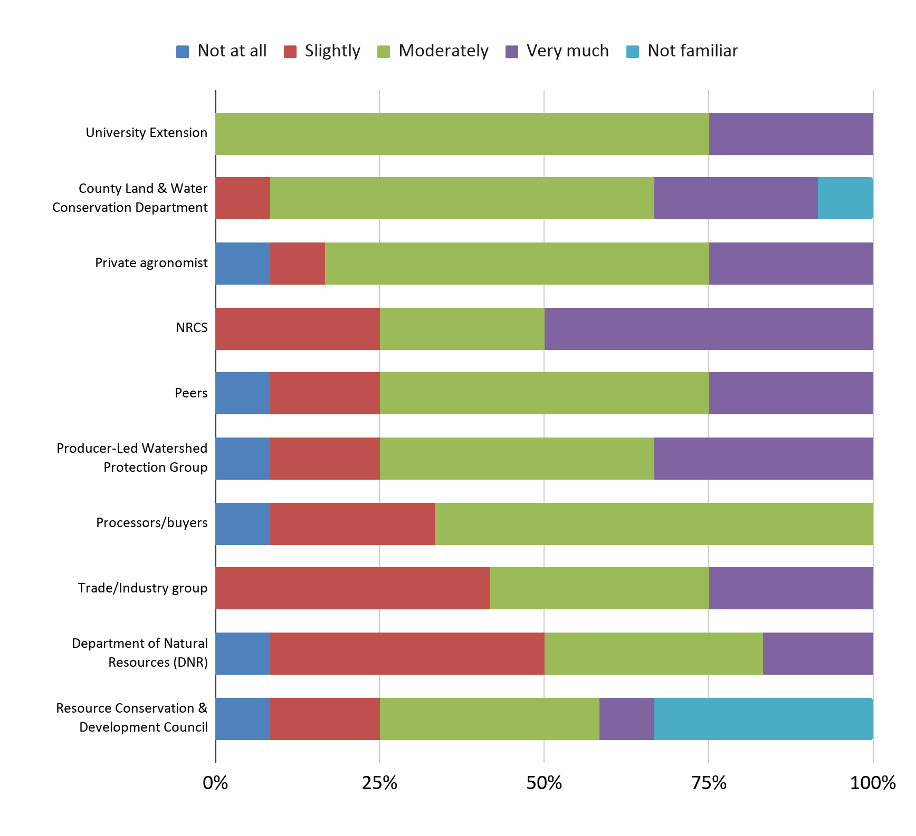
Box 1: Image Description ↓
A horizontal stacked bar chart displaying data from 0% to 100% across ten different organizational or peer entities. The legend contains five categories: “Not at all” (blue), “Slightly” (red), “Moderately” (green), “Very much” (purple), and “Not familiar” (cyan). The approximate value distributions per category from top to bottom are:
- University Extension: 75% Moderately, 25% Very much.
- County Land & Water Conservation Department: ~8% Slightly, ~58% Moderately, 25% Very much, ~9% Not familiar.
- Private agronomist: ~8% Not at all, !8% Slightly, ~59% Moderately, ~25% Very much.
- NRCS: 25% Slightly, 25% Moderately, 50% Very much.
- Peers: ~8% Not at all, ~17% Slightly, 50% Moderately, 25% Very much.
- Producer-Led Watershed Protection Group: ~8% Not at all, ~17% Slightly, 42% Moderately, 33% Very much.
- Processors/buyers: ~8% Not at all, 25% Slightly, ~67% Moderately.
- Trade/Industry group: ~42% Slightly, ~33% Moderately, 25% Very much.
- Department of Natural Resources (DNR): ~8% Not at all, ~42% Slightly, 33% Moderately, 17% Very much.
- Resource Conservation & Development Council: ~8% Not at all, ~17% Slightly, ~33% Moderately, 8% Very much, 34% Not familiar.
Responsibility and Willingness to Change
Participants showed a strong sense of responsibility and willingness to protect water quality and change management practices (Table 1). Multiple growers said that they were already using multiple conservation practices and are “trying the best we can” and “we would be willing to change if something is needed”. Other growers hesitated towards changing management practices, because they “don’t know the extent of change and we would have to take things slow”. A majority of participants agreed that using conservation management practices on farms improves water quality, but were not sure if and how conservation practices improve water quality, or how to measure improvement of water quality since they “have changed management practices” but are “still seeing an increase in nitrate”. This uncertainty was also expressed by the science community that these relationships remain challenging to understand and inform practice change. Such results demonstrate needs from all in communities to understand the interaction between ag practices and water quality outcomes, reaffirming the need for continued educational and outreach programming provided by programs such as Extension’s Agriculture Water Quality Program and the NRI Water Program.
| Please indicate your level of agreement or disagreement with the statement… | Agree | Strongly agree |
|---|---|---|
| I would be willing to change management practices to improve water quality. | 9 | 1 |
| I would be willing to pay more to improve water quality (for example: though local taxes or fees) | 2 | 1 |
| It is important to protect water quality even if it slows economic development. | 9 | 1 |
| It is my personal responsibility to help protect water quality. | 5 | 7 |
| My actions have an impact on surface water and groundwater quality. | 8 | 4 |
| The quality of life in my community depends on good surface and groundwater quality. | 8 | 3 |
| Using conservation management practices on farms improves water quality. | 10 | 1 |
Constraints to Change Practices
The survey helped identify limitations growers have when thinking about changing practices. The five most highly ranked hurdles in changing management practices are listed in Figure 4. The biggest constraint was concerns about reduced yield, which one participant also stated was the reason they don’t follow University recommendations for fertilization rates, especially N.
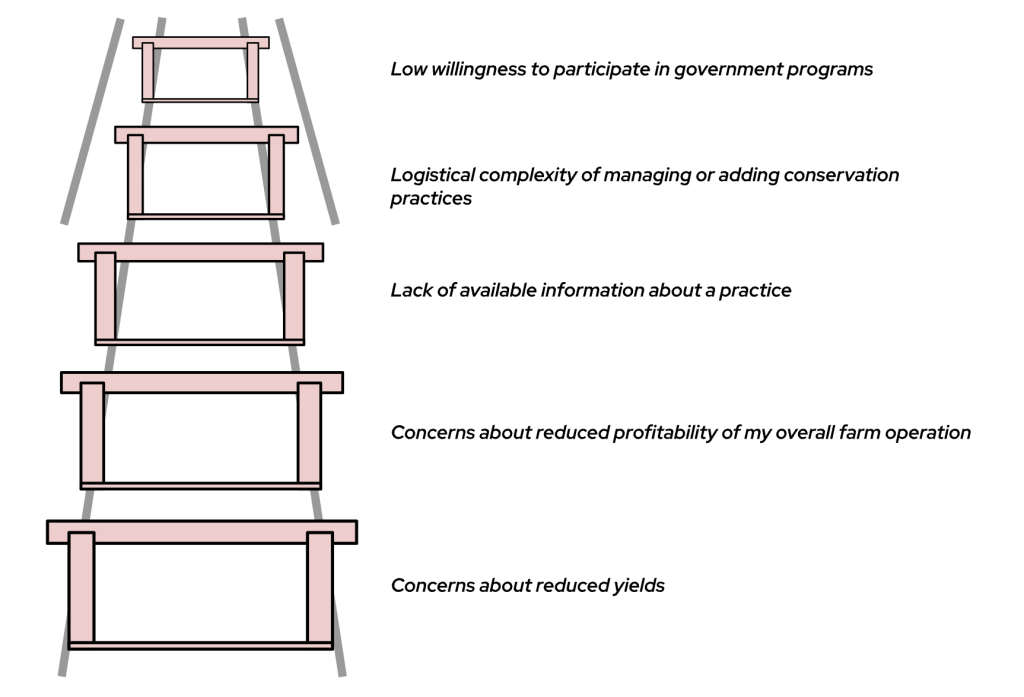
Figure 4: Image Description ↓
An illustrative graphic depicting five hurdles on a running track converging upward in perspective. Next to each hurdle, from top to bottom, is a line of text indicating specific barriers or user concerns:
- Top hurdle: Low willingness to participate in government programs
- Second hurdle: Logistical complexity of managing or adding conservation practices
- Third hurdle: Lack of available information about a practice
- Fourth hurdle: Concerns about reduced profitability of my overall farm operation
- Bottom hurdle: Concerns about reduced yields
Farmers in the follow-up focus group explained the dilemma they are facing with applying the “right” rate of fertilizer: applying less N improves water quality, but increases risks of yield reduction. Consumers are pushing for higher adoption of conservation practices yet the market incentivizes steadily increasing yield. Even though following university recommendations on N rate is considered a conservation practice, because N fertilizer is a relatively low cost input compared to projected profits in potato and vegetable markets, it creates an incentive to overapply N as a “yield insurance” for potato and vegetable farmers.
Implementing conservation practices in the multi-year vegetable cropping rotation can create unique logistical complexity. In such crop rotation, it is common to swap or rent land from neighboring operations. One of the participants said improving the soil while they are only renting does not generate a positive return of profit for them. Another participant mentioned that the heavy tillage required in potato production keeps them from even bothering with trying a conservation practice in a field where the rotation will include potatoes.
Outside of the top five constraints listed above, management requirements on contracts with processors were also identified as a constraint. From the interviews, we learned that some processors are recognizing the demand of regenerative practices from producers and consumers, and warming up to the idea of planting pea and green beans into fields with residue, especially from cover crops. However, some of the processor plants will still reject planting or harvesting fields with residue present because of standards of equipment and harvest material cleanliness.
A common conservation practice incentivised in Wisconsin is creating a Nutrient Management Plan (NMP). From this survey, 75% of the participants stated they don’t have a nutrient management plan, yet most of them are tracking fertility use in their own record-keeping systems from the interviews. Besides seeing the time and effort it takes to create a plan as a barrier, multiple participants in the follow-up session expressed that they would rather not submit their plans because they wouldn’t be able to apply for incentivised conservation practices offered to those with an NMP due to income limits and caps, even with a certified nutrient management plan.
Conclusion
This project illustrates the value of integrating social indicator surveys into watershed planning and conservation efforts. By engaging farmers through in-person interviews, we gained critical insights into their awareness, attitudes, and constraints regarding water quality and conservation practices. These conversations revealed both growers’ sense of responsibility for protecting water quality and significant barriers they face. Understanding these realities allowed us to design educational programs and outreach strategies that are relevant to local contexts.
The process was not without challenges. Translating survey findings into actionable programs requires time, trust building, and collaboration across multiple stakeholders. In person interviews, while highly effective for building relationships and nuanced understanding, demand considerate study design, local partnership, and time. Yet, the benefits far outweigh the costs.
For local conservation professionals seeking to strengthen relationships and achieve measurable improvements in water quality, conducting social indicator surveys – especially through direct engagement – offers tangible benefits. This approach fosters trust, informs programming that meets real needs, and creates pathways for long-term collaboration between watershed stakeholders and conservation professionals.
Reference
Genskow, Ken and Linda Prokopy (eds.). 2011. The Social Indicator Planning and Evaluation System (SIPES) for Nonpoint Source Management: A Handbook for Watershed Projects. 3rd Edition. Great Lakes Regional Water Program. (104 pages).
Published: July 9, 2026
Reviewed by:
- Izze McNamee, agriculture water quality outreach specialist, UW–Madison Extension
- Ellen Albright, Discovery Farms researcher, UW–Madison Extension
- Amber Radatz, agriculture water quality program manager, UW–Madison Extension
- Joe Bonnell, nutrient reduction strategy coordinator, Wisconsin Department of Natural Resources