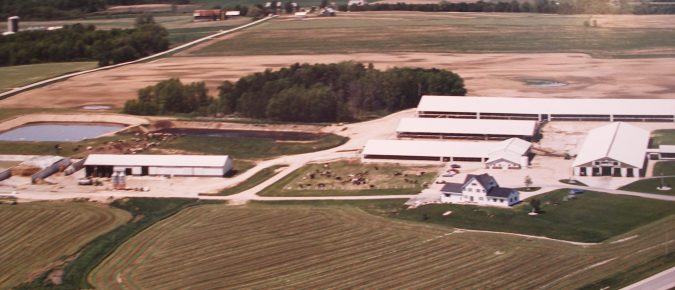
Farms near Lake Michigan in Manitowoc County, Wisconsin were facing a tough question: how much are agricultural fields contributing to water quality problems in the lake? Algae blooms in nearby bays were raising concerns, and phosphorus from farm fields was suspected as a key factor. To get real answers, Discovery Farms partnered with Saxon Homestead Farm (SHF), a fifth-generation, pasture-based dairy operation, to monitor water quality from 2004 to 2007.
From 2003 to 2008, researchers monitored both surface runoff and tile drainage at multiple field sites to understand how this large-scale farming system affects water quality on the fine-textured red clay soils common to northeastern Wisconsin.
From 2005 to 2009, Discovery Farms and the U.S. Geological Survey monitored surface runoff and tile drainage on two fields at Koepke Farms to measure how this system affects soil, phosphorus, and nitrogen loss.
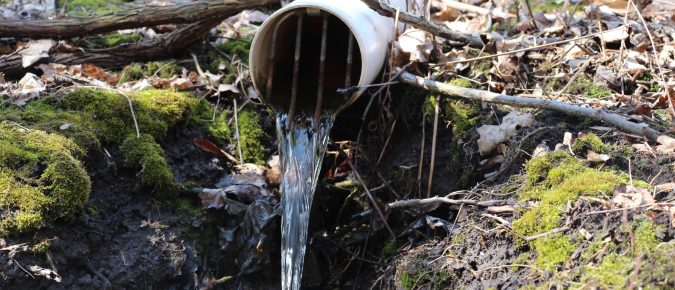
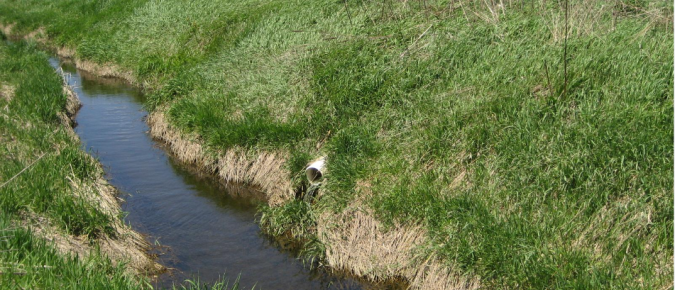
Because nitrate is negatively charged, it does not bind with negatively charged soil and readily moves with water. Typically nitrate losses are more prevalent in subsurface water like tile drainage, while high phosphorus and sediment losses are associated with surface waters. Although we do have highly accurate ways to measure tile drainage water quality, such as 24/7 automated flow samplers, this approach is typically not economically or logistically feasible for individuals looking to monitor tile drainage on their own farm.
The use of tile drainage is becoming more popular in Wisconsin. Installing a tile drain system can be a great tool to dry soil out faster, improving the timeliness of field operations throughout the cropping season. However, how do tile systems influence water movement off of the field, and what are the water quality implications?