This study was conducted from 2003-2008 and may no longer reflect current conditions as weather, management practices, and available data have evolved. This research remains valid, but should be considered alongside more recent findings.
Wisconsin farmers already use a range of conservation practices to protect water quality. But when do fields actually lose the most sediment and nutrients, and what conditions drive those losses? To answer that, the U.S. Geological Survey (USGS), Discovery Farms, and UW-Platteville Pioneer Farm teamed up to monitor edge-of-field runoff on six farms across southern Wisconsin from 2003 to 2008.
The study included a wide range of farming operations: two confinement dairies, a pasture-based dairy, a pasture-based organic dairy, a beef-finishing operation, and a mixed-livestock farm. All six farms had nutrient management plans and used conservation practices. The goal was not to single out any one farm, but to understand what conditions and timing drive runoff and water quality losses across different landscapes and farming systems.
How the Study Worked
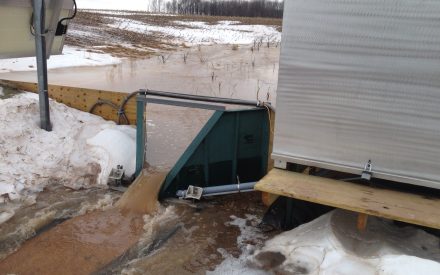
Researchers installed 23 edge-of-field monitoring stations across the six farms. Each station measured surface runoff volume and collected water samples during runoff events throughout the year, including winter. Samples were tested for suspended sediment (small soil particles carried in water), phosphorus, and nitrogen in multiple forms. Weather and soil conditions were tracked at each farm throughout the study.
What the Data Showed
Late winter is your most critical runoff window. February and March alone accounted for 50% of average annual runoff, even though only 11% of annual precipitation fell during those months. Runoff during March was recorded at every farm in every year of the study. Most of this runoff came from snowmelt or rain falling on frozen, snow-covered ground.
Spring is the second critical window. May and June contributed another 31% of annual runoff. Together, January through June accounted for 90% of total annual runoff. Summer and fall months, despite receiving more rainfall, produced very little runoff because growing crops absorbed most of the water.
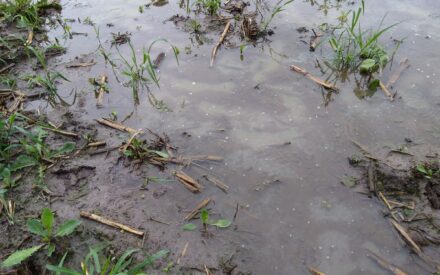
Sediment loss is driven almost entirely by unfrozen-ground runoff. Even though runoff was split nearly evenly between frozen and unfrozen ground periods (54% vs. 46%), 90% of sediment was lost during unfrozen-ground periods. May and June alone accounted for more than 80% of annual sediment loss. Mean annual sediment yields ranged widely, from 3 to nearly 5,000 lbs/acre, with an overall mean of 667 lbs/acre. The highest losses came from recently tilled corn fields during high-intensity spring rains.
Phosphorus moves in runoff year-round. Unlike sediment, phosphorus was consistently present in runoff regardless of whether the ground was frozen or thawed. Mean annual total phosphorus yields ranged from 0.03 to 7.0 lbs/acre, with an overall mean of about 2.0 lbs/acre. During frozen-ground periods, phosphorus moved mostly in dissolved form. During unfrozen-ground periods, it moved mostly attached to soil particles. Applying manure to fields just days or weeks before a runoff event was one of the strongest drivers of high phosphorus losses, especially during winter.
Nitrogen follows a similar pattern. Mean annual total nitrogen yields ranged from 0.11 to 19.2 lbs/acre, with an overall mean of 7.2 lbs/acre. Nitrogen and phosphorus losses were strongly correlated with each other and with monthly runoff amounts. Ammonium, which comes directly from manure, was most common in frozen-ground runoff. Cold temperatures slow the conversion of ammonium to other forms, keeping it available to move with runoff when manure is applied close to a weather event.
The Bottom Line for Wisconsin Farmers
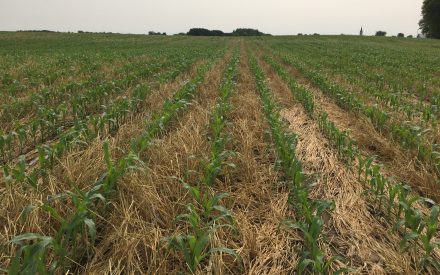
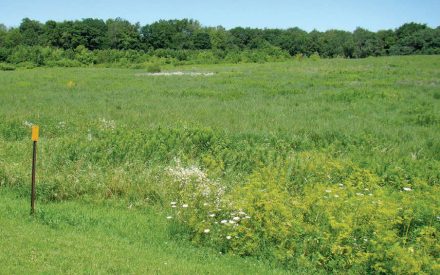
Conservation practices like grassed waterways and buffer strips use perennial vegetation to protect critical areas of farm fields year-round. This study shows that practices designed specifically for frozen-ground runoff are just as important as those used during the growing season.
The single most actionable finding: the timing of manure applications matters enormously. Fields that received manure within days or weeks of a runoff event consistently showed the highest nutrient losses, in both winter and spring. Extending the time between application and the next runoff event is one of the most direct ways to reduce nutrient losses to nearby water bodies.
Explore This Study in More Detail
This resource is meant for print purposes, only.