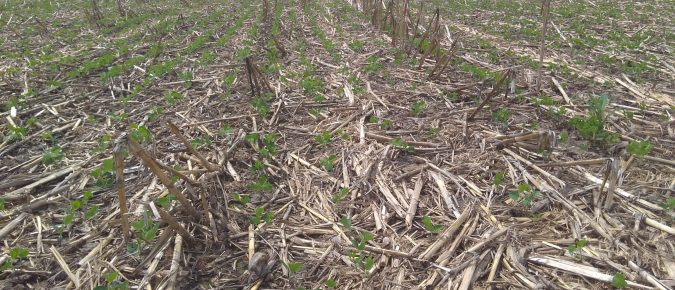
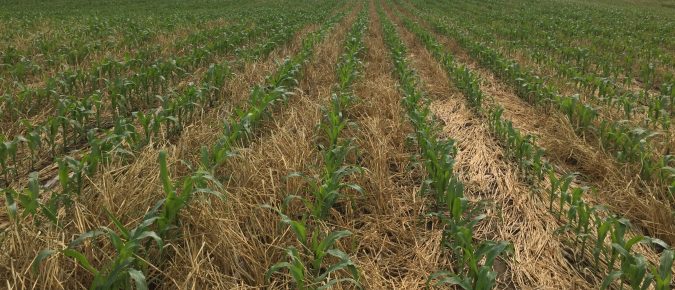
In Wisconsin’s Phosphorus Science Assessment, four practices were particularly effective at reducing total P losses: decreasing tillage intensity, adding edge-of-field filter strips, incorporating perennial or overwintering crops, and early establishment of cereal rye cover crops. Read this research brief to understand more about controlling P losses.
Areas where the natural topography causes runoff water to come together in a temporary stream are particularly vulnerable. Grassed waterways are a classic conservation practice that can help protect these sensitive areas while safely moving water off the field.
Since 2004, programs like Discovery Farms have been working with farmers in Kewaunee County to better understand how practices like cover crops and no-tillage can help keep nutrients on fields and out of waterways, positively impacting water quality.
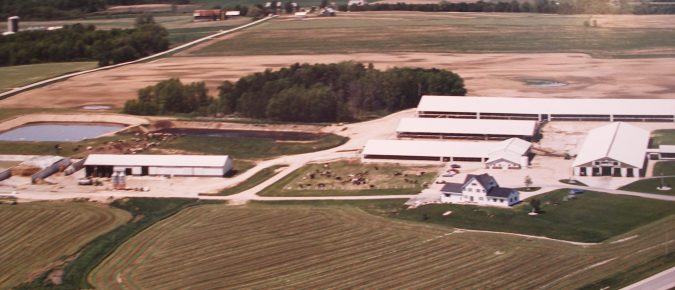
Farms near Lake Michigan in Manitowoc County, Wisconsin were facing a tough question: how much are agricultural fields contributing to water quality problems in the lake? Algae blooms in nearby bays were raising concerns, and phosphorus from farm fields was suspected as a key factor. To get real answers, Discovery Farms partnered with Saxon Homestead Farm (SHF), a fifth-generation, pasture-based dairy operation, to monitor water quality from 2004 to 2007.
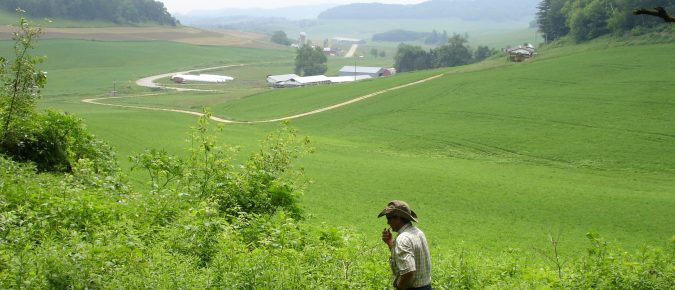
Farming on steep, hilly land is tough. Keeping soil and nutrients out of nearby streams is even tougher. But data from Bragger Family Dairy in Buffalo County, Wisconsin shows it can be done, and the lessons from this farm still matter today.
If you farm on steep slopes in Wisconsin, you’ve likely watched good soil wash away after a hard rain. That runoff carries more than dirt — it carries phosphorus and nitrogen that your crops need and that nearby streams don’t. A conservation tool called a grade stabilization structure (GSS) may be one of the most cost-effective ways to slow that loss down.
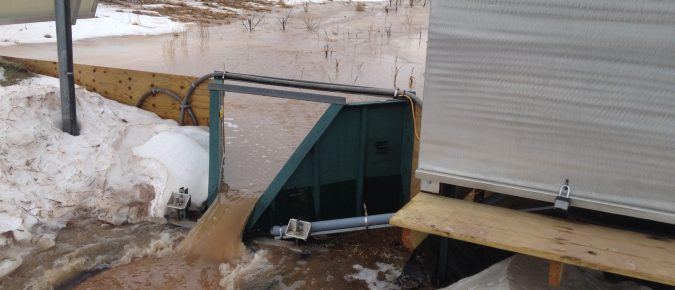
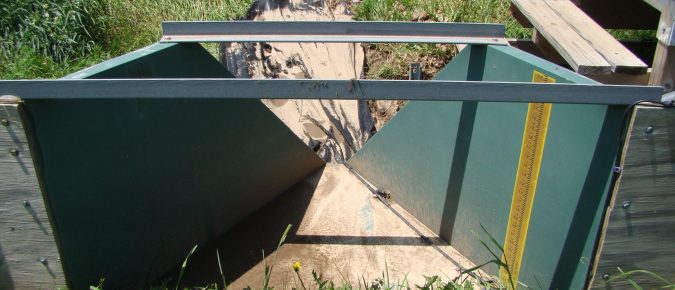
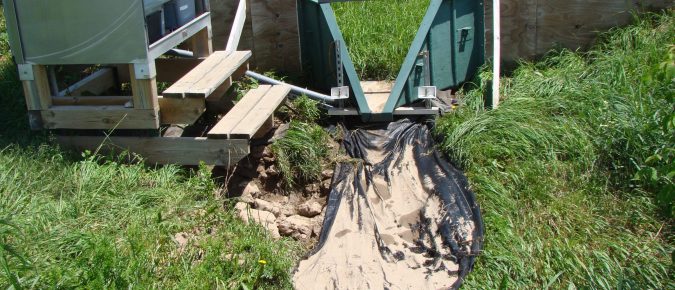
Wisconsin farmers know that what happens in the field does not always stay in the field. Rain and snowmelt carry sediment, nutrients, and other materials off farmland and into streams, tiles, and groundwater. But how do you know exactly how much is leaving, and when?
This study was conducted from 2003-2008 and may no longer reflect current conditions as weather, management practices, and available data have evolved. This research remains valid, but should be considered alongside more recent findings. Wisconsin farmers already use a range of conservation practices to protect water quality. But when do fields actually lose the most […]
Organic and grass-based dairy farms in southwest Wisconsin’s driftless region face a unique set of water quality challenges. The hilly, unglaciated landscape and shallow fractured bedrock create conditions very different from the rest of the state. To better understand how these farms affect water quality, Discovery Farms partnered with Heisner Family Dairy in Iowa County, Wisconsin to monitor water from 2004 to 2007.
From 2003 to 2010, Discovery Farms and the U.S. Geological Survey monitored surface runoff from three field watersheds to measure how this system affects soil, phosphorus, and nitrogen loss.
From 2003 to 2008, researchers monitored both surface runoff and tile drainage at multiple field sites to understand how this large-scale farming system affects water quality on the fine-textured red clay soils common to northeastern Wisconsin.
From 2005 to 2009, Discovery Farms and the U.S. Geological Survey monitored surface runoff and tile drainage on two fields at Koepke Farms to measure how this system affects soil, phosphorus, and nitrogen loss.