This study was conducted from 2001-2007 and may no longer reflect current conditions as weather, management practices, and available data have evolved. This research remains valid, but should be considered alongside more recent findings.
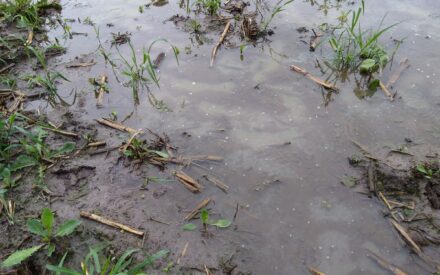
Wisconsin farmers know that what happens in the field does not always stay in the field. Rain and snowmelt carry sediment, nutrients, and other materials off farmland and into streams, tiles, and groundwater. But how do you know exactly how much is leaving, and when? That is the question this research set out to answer.
Starting in 2001, the U.S. Geological Survey (USGS) partnered with the Discovery Farms program and UW–Platteville Pioneer Farm program to collect detailed water quantity and water quality data from working farms across southern Wisconsin. The goal was to measure runoff from fields year-round, including during winter, when data had historically been missing.
Why Winter Monitoring Matters
Most earlier farm monitoring focused on the growing season, roughly April through October. But Wisconsin winters bring snowmelt, freeze-thaw cycles, and manure applications on frozen ground, all of which can move pollutants into nearby water. Researchers found that collecting data only in warmer months left a significant gap in understanding the full picture of farm runoff.
How the Monitoring Network Worked
USGS staff installed and maintained monitoring stations at 25 edge-of-field locations, 6 stream measurement sites, and 5 subsurface tile drainage sites across 7 Discovery Farms and Pioneer Farm. Edge-of-field stations measured surface runoff flowing off crop fields. Subsurface tile stations tracked water moving through underground drainage pipes. Stream stations measured flow in small agricultural streams.
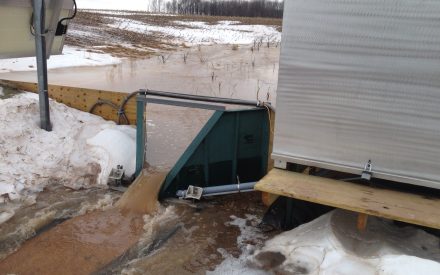
Each station used a structure called an H flume or trapezoidal flume to measure how much water was flowing past. Automated samplers collected water samples during runoff events so that nutrients like phosphorus and nitrogen, as well as sediment, could be measured in the lab. Meteorological stations at most farms recorded precipitation, temperature, soil moisture, and other conditions.
Solving the Problem of Winter Equipment Failures
Cold weather caused real problems for equipment. Ice clogged flumes, froze sampling lines, and gave incorrect readings. The research team tried many solutions, including heat tape, propane heaters, dark-colored flumes that absorbed sunlight, and insulated covers. Heat tape applied to the floor of the flume near the water sampling line proved to be one of the more effective tools, reducing freezing at critical points. However, the report is clear: frequent station visits during winter remained essential and could not be replaced by technology alone.
What the Data Revealed
Samples collected during runoff events were combined into a single composite sample for each event. This gave researchers one average concentration value per event, which was then multiplied by the total runoff volume to estimate how much of each nutrient or sediment load actually left the farm. Annual sample coverage was typically 90 percent or greater, meaning very few runoff events went unsampled.
Why This Matters for Your Farm
This monitoring network produced the kind of detailed, year-round data needed to understand how farm management practices affect water quality. The methods developed here can be applied across a wide range of farm types and landscape settings in Wisconsin, making this work a strong foundation for future conservation efforts.
Explore This Study in More Detail
This resource is meant for print purposes, only.