This study was conducted from 2001-2008 and may no longer reflect current conditions as weather, management practices, and available data have evolved. This research remains valid, but should be considered alongside more recent findings.
If you farm on steep slopes in Wisconsin, you’ve likely watched good soil wash away after a hard rain. That runoff carries more than dirt — it carries phosphorus and nitrogen that your crops need and that nearby streams don’t. A conservation tool called a grade stabilization structure (GSS) may be one of the most cost-effective ways to slow that loss down.
What Is a Grade Stabilization Structure?
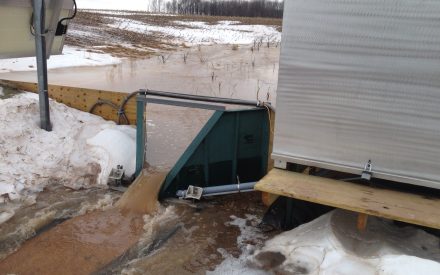
A GSS is a sturdy earthen embankment built on a hillside or in a grass waterway. When runoff rushes downhill, the GSS slows it down and holds it long enough for soil particles to settle out before the water moves on. Unlike a pond or sediment basin, a GSS lets that captured water soak into the ground rather than just holding it in place.
GSSs are built to last at least 15 years and need little upkeep. Installation costs range from around $4,000–$5,000 on ridge sites to $6,000–$8,000 in valley locations, though some sites can run higher.
What Does the Research Say?
Discovery Farms, working with the U.S. Geological Survey, tracked the results of one GSS over eight years on a Buffalo County farm in Wisconsin’s Driftless Region, an area known for its flat ridges, steep side slopes, and narrow valleys that make it especially prone to erosion.
Researchers compared two side-by-side watersheds — one with a GSS installed, one without — before and after installation. The results were clear:
- Sediment in runoff dropped by 73% in the watershed with the GSS.
- Total phosphorus (TP) fell by 62%. Phosphorus is a nutrient that fuels harmful algae growth in streams and lakes when it shows up in excess.
- Total nitrogen (TN) dropped by 51%.
Soil samples taken inside the GSS showed higher clay content than samples taken outside it, direct evidence that fine particles were being captured and held by the structure rather than washing downstream.
One important note: the GSS reduced phosphorus and nitrogen that were attached to soil particles (called particulate P and N). It did not reduce dissolved nutrients already in the water. That’s simply not what it’s designed to do. For dissolved nutrients, other practices would need to be layered in.
Is a GSS Right for Your Farm?
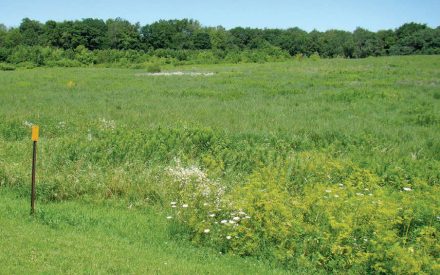
A GSS works best on farms with flat ridge tops and steep side slopes. Ideal spots include existing grass waterways or areas where gully erosion is already a problem.
Researchers recommend using a GSS alongside other conservation practices for the greatest impact on water quality. In areas like the Driftless Region, installing multiple GSSs across a watershed could make a meaningful difference in the health of local streams.
If protecting your soil and cleaning up your farm’s runoff are priorities, a GSS is worth a serious look.
Explore This Topic in More Detail
These supplemental resources are meant for print purposes, only.
Conservation Benefits of a Grade Stabilization Structure (PDF) ↗️
At-grade stabilization structure impact on surface water quality of an agricultural watershed (PDF) ↗️ (originally published in the Journal of Environmental Management)
An at-grade stabilization structure impact on runoff and suspended sediment (PDF) ↗️ (originally published in the Journal of Soil and Water Conservation)