This study was conducted from 2012-2014 and may no longer reflect current conditions as weather, management practices, and available data have evolved. This research remains valid, but should be considered alongside more recent findings.
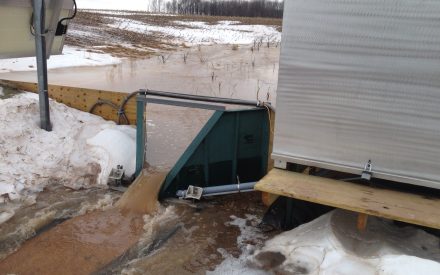
The Discovery Farms Program monitored leachate collection systems on three private farms in Wisconsin from 2012 through 2014. 550 events were sampled to better understand the quantity and timing of nutrient loss from bunker silos. There is a clear risk of nutrient loss from feed storage areas. To reduce nutrient loss on a farm scale, paying special attention to feed storage area management is important. On farms monitored by Discovery Farms, data revealed relatively consistent loading through events.
Nutrients and Management
Feed storage areas run off more than farm fields.
Unlike fields, feed storage areas are impervious making them more likely to run off. Over seventy percent of precipitation ran off feed storage areas, compared to nine percent on Discovery Farms monitored farm fields. As little as 0.01 inches of precipitation produced runoff from feed storage areas, which is ten times less than the minimum rainfall required to produce runoff from farm fields.
One acre of feed storage can lose as much nitrogen and phosphorus as 120 cropland acres.
Feed storage areas may only cover a small amount of the total acres on a farm, but their potential water quality impacts can be considerable. Feed storage areas must be managed properly and equipped with necessary treatment measures to minimize water quality impacts.
Long suggested measures for preventing loss are important to maintain.
How much water makes contact with feed and how long that water is in contact with it influences nutrient loss. There are many management practices that can help minimize the water-feed interaction and keep nutrient-rich water contained:
- Reduce moisture in feed. Harvest forages at the appropriate moisture content, if possible.
- Protect silage from making contact with water. Properly cover silage and retaining walls and divert clean water.
- Keep the feed pad clean. Remove litter and spoil piles.
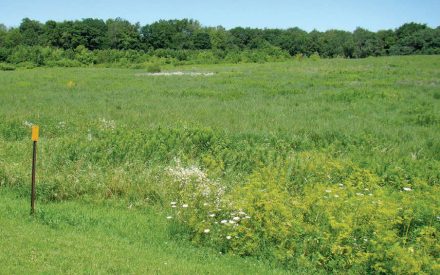
- When runoff happens, ensure nutrients are captured. Maintain the feed pad and walls, collection system, and vegetative treatment area (VTA).
Liquid leaving feed storage areas can be nutrient rich, but not always. Systems must be designed to capture liquid when it contains high levels of nutrients and organic acids in order to protect water quality without capturing unnecessary amounts of low-risk water.
Collection System Design
Feed storage runoff behaves differently than urban runoff, the current basis
for system design.
In urban environments there is very little to hold contaminants back. When runoff begins, contaminants are generally washed off of the impervious surface and immediately swept away. This phenomenon is known as first flush, and is the basis for urban and current leachate system design. However, on monitored farms.
- No first flush existed in any event when using a strict definition of first flush (80% of event load by 30% of event volume)
- Only 3% of events had a first flush using a moderate definition (40% of event load by 20% of event volume)
- Unlike in urban environments, in feed storage areas the source of nutrients (feed) is not swept away so the contaminant load is usually relatively consistent throughout an event
Alternative designs may be more efficient than current designs.
Periods of low flow often occur at the beginning and end of runoff events. When there is high flow and the load is constant, the load is more diluted and could be filtered adequately by a VTA. The same load during periods of low flow leads to very concentrated liquid that should be captured. Basing collection on flow rate, rather than time, is a feasible strategy to improve efficiency.
- Low flow only collection would collect flow below a certain flow rate threshold. Continuous flow would collect up to a given flow rate throughout an event.
- Given an equal volume, low flow and continuous flow capture methods were more efficient than first flush collection on two of three farms.
- Nitrogen, phosphorus, conductivity, chemical oxygen demand, total solids and pH were monitored. All constituents monitored were statistically correlated except pH. Conductivity correlated the best with all other measures. Since they are statistically correlated, real time monitoring of only one constituent could be used to direct flow to collection or a VTA.
Factors that most influence nutrient loss are unclear.
In partnership with Discovery Farms, Dr. Becky Larson, UW–Madison Biological Systems Engineering, analyzed feed volume, feed type, rain event duration and size, and how much time passed between filling and runoff to see if any one factor had a clear and considerable impact on nutrient loss. No one factor was found to be the main driver of loss.
Understanding losses from feed storage is not straight forward and every situation is different. Engineers and agencies need to collaborate to determine economically and environmentally viable treatment options.
Explore This Topic in More Detail
These supplemental resources are meant for print purposes, only.
Silage storage runoff characterization: Annual nutrient loading rate and first flush analysis of bunker silos (PDF) ↗️ (originally published in Agriculture, Ecosystems, and Environment)
Evaluation of Silage Leachate and Runoff Collection Systems on Three Wisconsin Dairy Farms (PDF) ↗️